


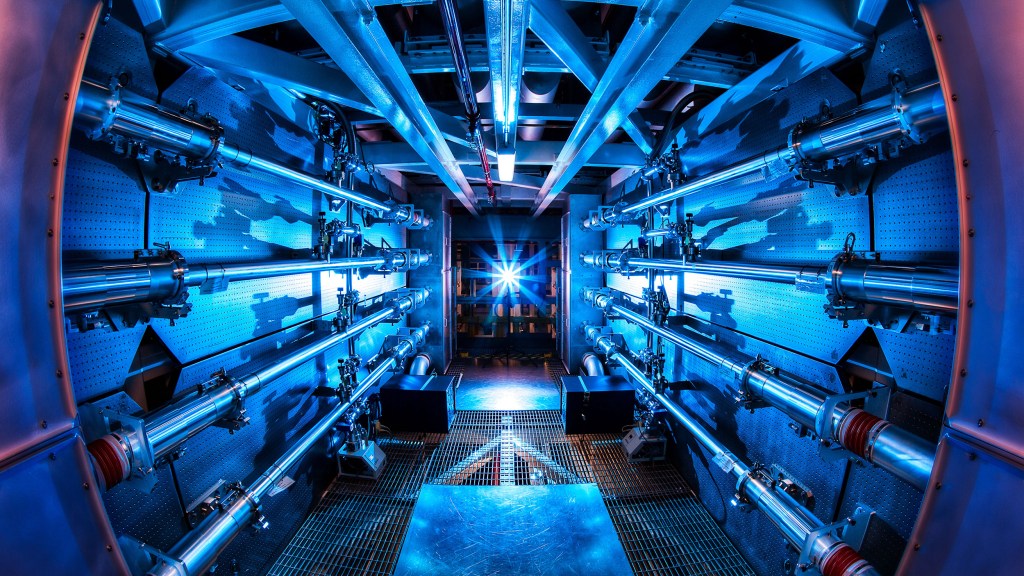
This week, the US Department of Energy announced that its laboratory in Livermore, California reached a milestone in nuclear fusion energy development. On December 5, Lawrence Livermore National Laboratory achieved net energy gain. Dr. Kim Budil, Director of LLNL, said, “The pursuit of fusion ignition in the laboratory is one of the most significant scientific challenges ever tackled by humanity, and achieving it is a triumph of science, engineering, and most of all, people.”
Fusion energy powers the sun. It occurs when hydrogen is heated and compressed so much that it fuses into helium and releases energy at the same time. Recreating this on earth has been a goal for decades, but it requires recreating the conditions found inside the sun. The National Ignition Facility at LLNL uses lasers to do that. LLNL started this work in the 1960s and over the decades built the world’s largest laser array—the size of a sports stadium. Earlier this month, 192 lasers fired at a pellet of deuterium and tritium (hydrogen with extra neutrons, commonly found in sea water) compressing it to 100 times denser than lead and heating it to 100 million degrees Celsius. The resulting explosion yielded 3.1 megajoules (MJ) of fusion energy. Since the lasers invested only 2.0 MJ, the net energy gain was 1.5—more than doubling last year’s record.
In my book, World Leadership, I predicted that nuclear fusion would someday become the world’s next preconditioning innovation, i.e., it would forever change the technological and then political landscape of the world. When I did the research back in 2008, this was my riskiest conclusion. Now, it seems obvious that science is well on-track for this to come true, though the political transformation is still decades away.
Despite this breakthrough, the technology also has a long way to go. The output (3 MJ) is only enough to power the average home for 43 minutes. Moreover, it took about 300 MJ to power the lasers, so the output was far smaller than the total energy input. Nonetheless, it is a substantial proof-of-concept. So while this is neither the beginning nor the end, it is certainly an impressive middle.
Source:
Department of Energy, press release: “DOE National Laboratory Makes History by Achieving Fusion Ignition,” 12/13/2022.
Ella Nilsen and Rene Marsh, “US Scientists Reach Long-awaited Nuclear Fusion Breakthrough,” CNN, 12 December 2022; accessed from https://www.cnn.com/2022/12/12/politics/nuclear-fusion-energy-us-scientists-climate/index.html
Shannon Osaka, “What You Need to Know About the US Fusion Energy Breakthrough,” Washington Post, 12 December 2022; accessed from https://www.washingtonpost.com/climate-solutions/2022/12/12/nuclear-fusion-breakthrough-benefits/
Rahul Raq, “What the Energy Department’s Laser Breakthrough Means for Nuclear Fusion,” Popular Science, 13 December 2022; accessed from https://www.popsci.com/science/nuclear-fusion-laser-net-gain/
Photo: Damien Jemison (LLNL)