


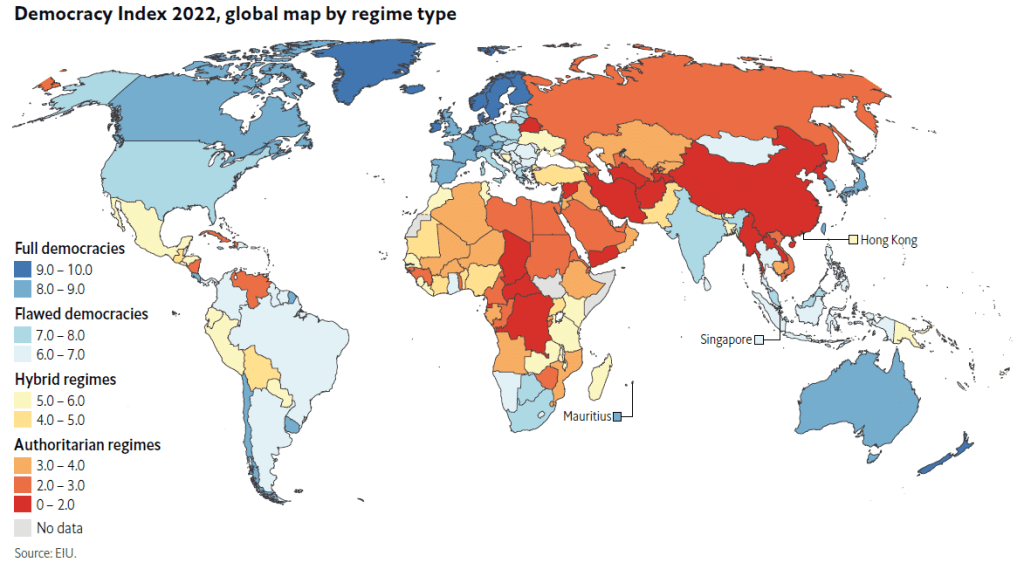
The last eight articles have featured countries struggling with democracy. Some were trying to hold on to it, while others had abandoned it. Other were moving toward it but had a long way to go. Looking at them collectively provides insight into a potential path forward for each of them.
Each of the eight countries profiled over the last few weeks has a unique situation, yet many share something in common. Brazil is a democracy where a small minority tried to provoke a coup d’état. El Salvador is a democracy trying to suppress its greatest threat—gangs. Mexico is a democracy where cartels control huge swarths of the country. Tunisia has all but given up democracy after it failed to solve economic problems. Somalia is moving toward democracy, though tribal and ethnic alignments often predominate. Nicaragua is a dictatorship, whose people want to return to democracy. Chad is a dictatorship that recently ended its quasi-democracy. And Haiti has fallen from quasi-democracy to a chiefdom run by gangs. What most of them share is a lack of understanding on how to move forward, and where forward even is. However, there is a concept that may help.
There is a natural progression that runs from fiefdom (e.g., a kingdom) to democracy. Each of these countries lies along this progression (except for Haiti, which is currently below fiefdom). If a handful of predetermined, stable government configurations along this spectrum can be defined, these countries could use them as steppingstones toward democracy. Right now, these societies shift positions along this spectrum in a haphazard manner, often leading to bad results. However, moving one step at a time would allow these societies to develop the right mindset, institutions, and checks & balances needed to sustain rule-of-law.
I proposed a similar approach in World Leadership for resolving the Syrian Civil War. The progression follows the natural path toward nation-state first seen in Europe in the Early Modern Age. An accelerated version of this could prove effective at preserving stability while enabling governments to mature and better respond to the needs of their people. The configurations would take research and effort to develop, but the concept is sound.
Source:
Neil Hamblin, World Leadership, 2017.
Photo: Economist Intelligence Unit, February 2023