


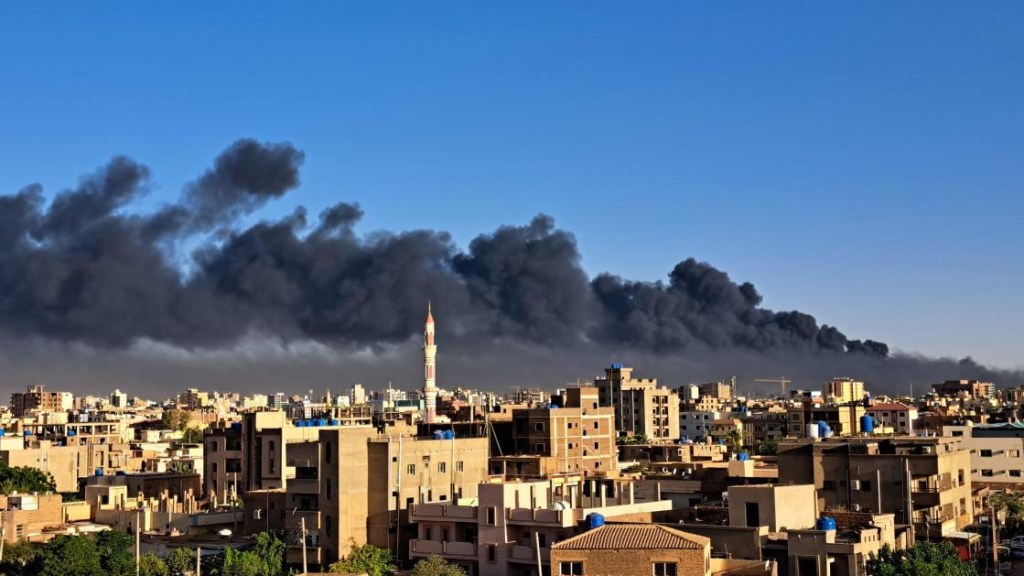
On April 15, 2023, two Sudanese generals began fighting for control of the country. Sudan had appeared to be on the road to democracy, but in the early weeks of fighting, over 600 civilians were killed, tens-of-thousands were displaced, and aid organizations fled. It all begs the question: What happened?
In April 2019, the dictator who had run Sudan for 30 years was ousted by the Sudanese army. In the weeks that followed, a government was formed, with an army general and several civilian leaders in charge. One of those civilian leaders was the head of the Rapid Support Force (RSF), a military organization formed in 2013 by the former dictator. Driven by international conditions for making loans and relieving debt, civilian leaders began investigating the business interests of the army general and RSF leader. Both ran state-owned enterprises, private enterprises, petroleum operations, and even gold mines. Feeling threatened, the general and RSF leader overthrew the government in October 2021. With the help of other countries, a path toward democracy was drafted, but unsurprisingly, the arrangement broke down. (The principle sticking point was the timing of when the RSF would be folded into the army.) While it’s not clear who fired the first shots, within hours, airstrikes and artillery bombardments savaged the country.
Fledgling democracies often are hamstrung by conditions left from prior dictatorships. Internal security forces are often used by dictators to counterweigh the military. High-level officials are often given businesses and even monopolies to support the regime. Separation of powers is generally muddled, and checks and balances on power are weak. All these conditions were present in Sudan before the fighting ever began. As such, the nation’s fate was largely sealed even before it embarked on the road to democracy.
While some in Sudan blame the US for not taking a stronger stand against the coup, it is not clear this would have made a difference. Rather, a strategic plan and actions that removed harmful conditions and established the requisites for democracy were needed as soon as the old dictator was ousted. Without an aggressive, informed approach to establishing the right foundation, it is doubtful any intervention from the US, or anyone else, could have helped.
Source:
Katharine Houreld, Hafiz Haroun, “How Did Sudan’s Revolutionary Spring Wither?” Washington Post, 14 May 2023, A19; see also https://www.washingtonpost.com/world/2023/05/07/sudan-democracy-fighting-burhan-hemedti/
Photo: Anadolu Agency, Getty Images