


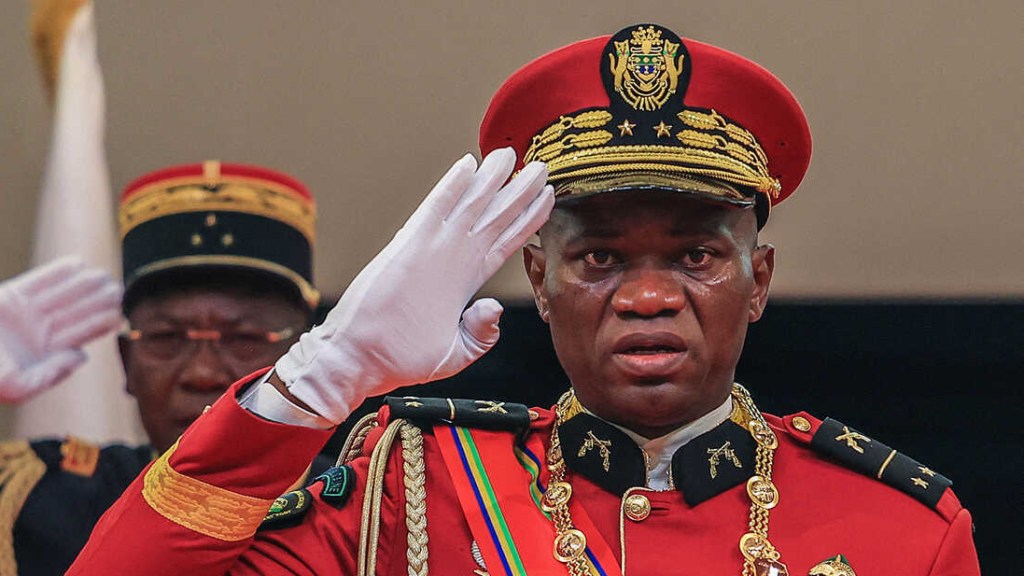
One month after a coup in Niger, another African country met a similar fate: the president of Gabon was ousted by the military. It was the seventh coup in Africa in the last three years, six of which occurred in the Sahel region, and all of which were former French colonies.
On August 30, army officers appeared on Gabon’s national television saying the military had seized power, dissolved the parliamentary government, and closed the borders. Celebrations erupted across Gabon’s major cities and residents in the capital were seen embracing soldiers on the streets. President Ali Bongo was placed under house arrest, and the military named General Brice Oligui as the transitional leader. Such was the end of family rule that began in 1967. Omar Bongo reigned for almost 42 years. He imposed a one-party system until 1991. His son, Ali Bongo, took over in 2009 and immediately faced accusations of election fraud and corruption. His three elections were disputed and spawned nationwide protests. Meanwhile, the country remained oil-rich but poverty-stricken. The Bongo family amassed incredible wealth—39 French properties, 70 bank accounts, cars worth 1.5 million euros—while 30% of the population lived in poverty. Youth unemployment (15- to 24-year-olds) runs at about 40%.
Gabon was a democracy in name only: all government mechanisms were oriented toward perpetuating the family dynasty. A lack of controls could not ensure free and fair elections so the family remained in power decade after decade. Ultimately, the military had to remove the corrupt regime. The UN often monitors national elections, but it has no teeth if things are not done right. In Africa, the African Union or ECOWAS might be better suited for this role: both seem more willing to exert force if things are not conducted properly. African oversight may also help avoid the lingering resentment of European authority on the continent.
After the coup, the opposition leader thanked the military, but then asked them to cede power to the challenger in the election. Gen. Oligui said that new elections will be held “quickly and surely” but that he needed time to ensure the next election is credible. No timetable has been set.
Source:
Jessie Yeung, “Gabon’s Military Coup had Overthrown a Powerful Political Dynasty. Here’s What to Know,” CNN, 31August 2023; accessed from https://www.cnn.com/2023/08/31/africa/gabon-military-coup-explainer-intl-hnk/index.html
Emmanuel Akinwotu, “A Gabon Miliary Coup Leader is Sworn in as Interim President, Promising Elections, NPR, 4 September 2023; access from https://www.npr.org/2023/09/04/1197535081/gabon-coup-military-leader-sworn-in-president
Ishan Tharoor, “Former Colonize, France, Faces a Reckoning Amid a Wave of Coups in West Africa,” Washington Post, 3 September 2023, A17; see also https://www.washingtonpost.com/world/2023/09/01/france-africa-coup-reckoning-colonial-history/
Photo: AFP via Getty Images