


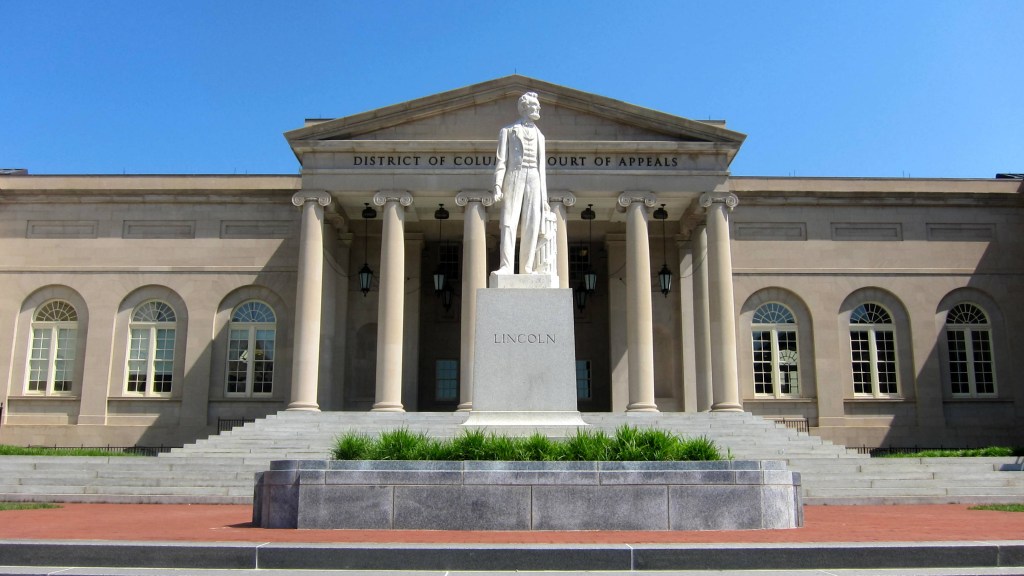
The Justice Department has long held that a sitting president would not be prosecuted. However, an appellate court recently had to decide whether this protocol extended to a former president who committed a crime while holding office.
This week, the federal appeals court in Washington DC addressed whether former president Donald Trump could be prosecuted for helping foment a riot at the capitol on January 6, 2021. The Trump legal team argued that he was immune from prosecution because he was in office at the time. The judges—two Democrat-appointed and one Republican-appointed—disagreed, saying that once he leaves office, he is a citizen like anyone else. Trump’s legal team argued that without immunity, every future former president will be indicted by the sitting president. The judges pointed out that this has never happened in US history, and that other presidents faced consequences after leaving office (Nixon for Watergate, Clinton for Lewinsky). Trump’s team argued that prosecuting him after having been impeached violates double jeopardy prohibitions. The judges pointed out that impeachment is a political procedure, not a criminal proceeding. Trump’s team argued that a president had to first be convicted at an impeachment trial before he could be prosecuted. During oral arguments, one judge said that would imply a sitting president could order Seal Team 6 to take out a political rival with impunity. Trump’s lawyer agreed but stated that such a move would likely result in impeachment. In the end, the judges concluded that granting unending immunity “would neutralize the most fundamental check on executive power.”
It is a tribute to our form of government that such a proposition would even be seriously entertained. The United States has survived for nearly 250 years, while other countries succumbed to multiple revolutions, in large part because our system of checks and balances and separation of powers has been so sophisticated. Granting immunity to a former president would throw a wrench into that system and lead to a dictatorship.
At times, the judges seem to overstep the scope of the trial by commenting that a president cannot overturn election results. This, arguably, is for another trial to decide. Nevertheless, they got the basic point right: no one is above the law. As a parting shot, the judges gave Trump only until February 12 to appeal to the Supreme Court: they were going to make sure this issue was settled before the next election.
Sources:
Alan Feuer, Charlie Savage, “Federal Appeals Court Rejects Trump’s Claim of Absolute Immunity,” New York Times, 6 February 2024; accessed on from https://www.nytimes.com/2024/02/06/us/politics/trump-immunity-appeals-court.html
Rachel Weiner, “Trump Has No Immunity from Jan 6 Prosecution, Appeals Court Rules,” Washington Post, 6 February 2024; accessed from https://www.washingtonpost.com/dc-md-va/2024/02/06/trump-jan-6-immunity-appeal-denied/