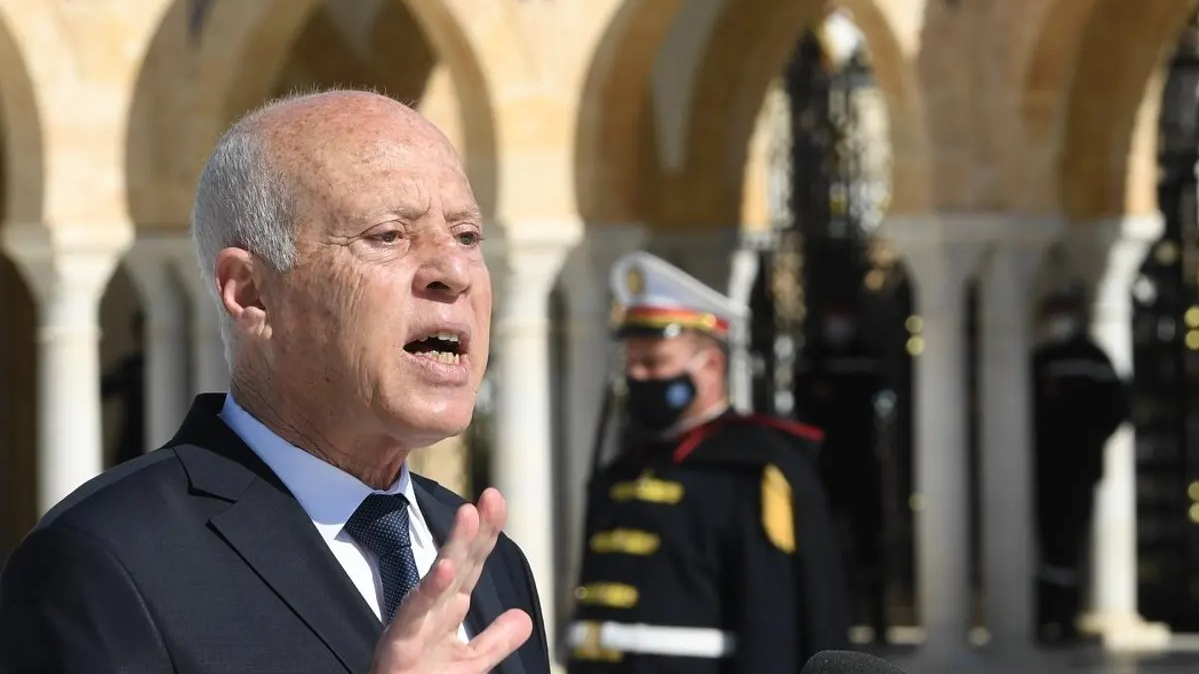
Tunisians didn’t turn out for their recent election. In a country of 7.8 million voters, only 887 thousand, or 11%, voted. The poor turn-out is considered a rebuke of president, Kais Saied, and his power grab that began in July 2021.
In July 2021, Saied suspended parliament and dissolved the government. After protests began against economic hardship and a poor COVID-19 response, he invoked emergency powers. He began to imprison members of parliament and judges who opposed him. In September, he introduced a law that granted him the ability to change the constitution and dissolve parliament. The law also weakened political parties, favored wealthy candidates, limited those who could run for office, and shrank the size of parliament. In October, he formed a new parliament that has no power to hold him accountable. In February, he dissolved the nation’s top independent judiciary. In May, he was found to be imposing restrictions on the press. In July, he pushed through a new constitution with only 30% of the electorate voting. Initially, many Tunisians supported Saied’s power grab, blaming years of weak coalition government for the economic debacle. However, support waned when he failed to address the economic issues or even present a plan. He simply chose to rail against corruption and unnamed speculators. In December, only 9% of the electorate turned out for a parliamentary election; in January, only 11%.
Tunisia was the only victory of the Arab Spring—the only democracy to emerge. Now it is reverting to a dictatorship. Years of economic stagnation have taken its toll and people have become desperate. Yet the poor election turn-out suggests people are not happy with the direction Saied is taking the country. The spirit of the Arab Spring is still alive.
The European Union, formerly a stanch Saied supporter, did not observe this recent election. The US cut its military and civilian assistance in half for 2023. The IMF delayed an urgently needed $1.9B loan. Sadly, there is a growing feeling that the current political leadership cannot solve the country’s inflation, unemployment, corruption, and inequality problems, and that this is fueling revolutionary sentiment.
Source:
“Thousands Protest Against President,” AP, 15 January 2023
“Tunisian Election Records 11% Turnout in Rejection of President’s Reforms,” The Guardian, 29 January 2023; accessed from https://www.theguardian.com/world/2023/jan/30/tunisian-election-records-11-turnout-in-rejection-of-presidents-reforms
Haythem Guesmi, “Tunisia’s Election: The Beginning of the End for Saeid,” Aljazeera op-ed, 19 December 2022; accessed from https://www.aljazeera.com/opinions/2022/12/19/tunisias-election-the-beginning-of-the-end-for-saeid
Sarah Yerkes, Mohammad Al-Mailam, “Tunisia’s New Electoral Law is Another Blow to its Democratic Progress,” Carnegie Endowment for International Peace report, 11 October 2022; accessed from https://carnegieendowment.org/2022/10/11/tunisia-s-new-electoral-law-is-another-blow-to-its-democratic-progress-pub-88127
“2021 Tunisian Self-coup,” Wikipedia, accessed 2 February 2023.
Photo: Anadolu Agency/Getty Images
One response
This is fascinating. Would like to know more of the geopolitical impacts globally.
And, for our younger generations, an historical review of the rise and fall of dictatorships and cycles of empowered electorates ebbing into loss of freedoms may help attach fundamental geo-socio-economic-lessons to our current geopolitical world. This is critical, with the WWII generation’s passing, the current govt-populace relationships and the global balance of power. One might compare the current events: European war, Asia Pacific struggle (now China as aggressor vs Japan), global inflation & pandemic to the first decades of the 20th century.