Author
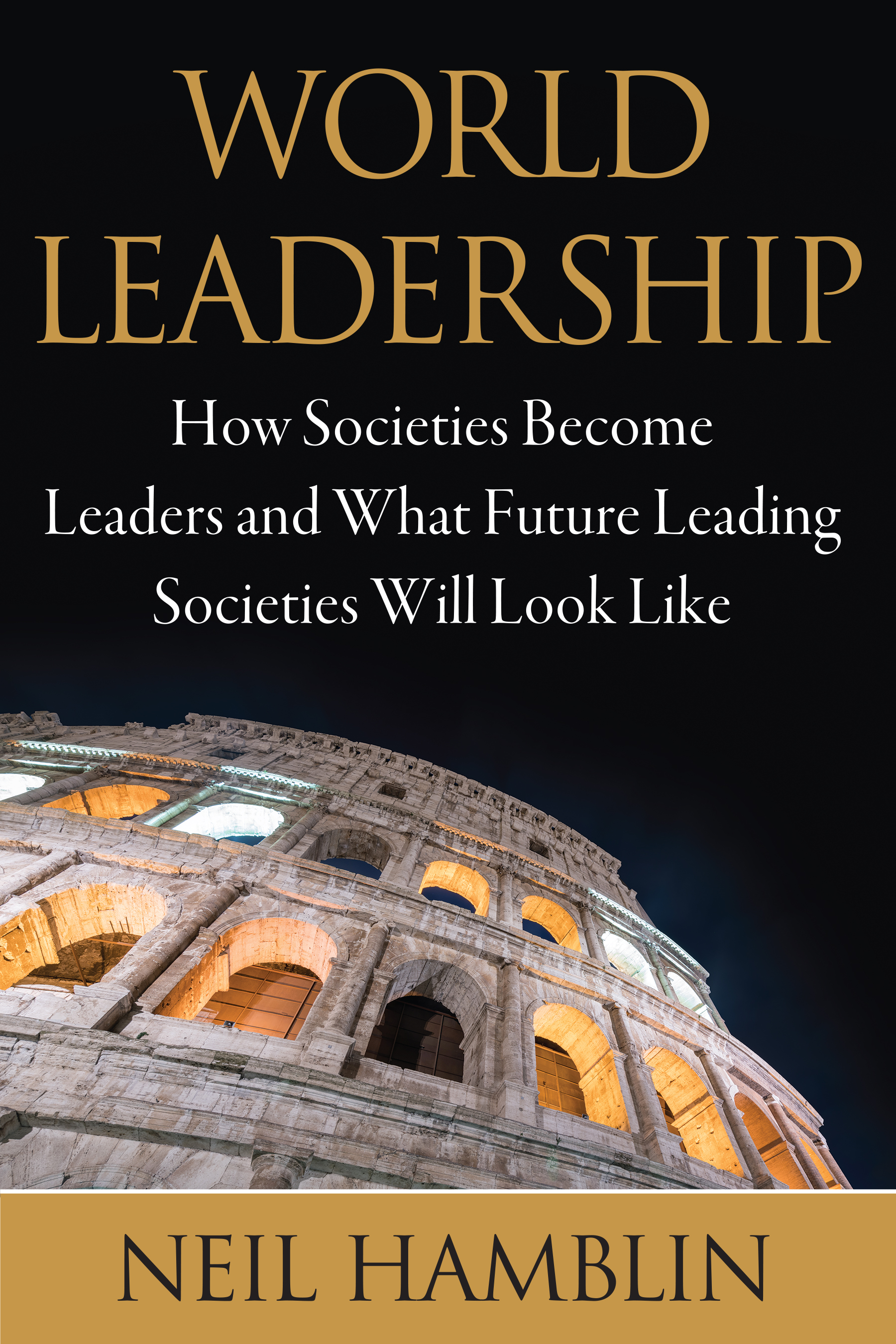
Neil Hamblin loves history but examines it like an engineer. He does not divide history into eras or epochs (e.g., the Middle Ages). He does not restrict it to a particular geography (e.g., Europe). He does not focus on a single subject (e.g., art). Rather he looks at the cause-and-effect actions that made history unfold. He calls this Active History, and his findings are published in World Leadership: How Societies Become Leaders and What Future Leading Societies Will Look Like, a 5-star rated book focused on history, our future, and our geopolitical world today.

Background
In the summer of 2006, Mr. Hamblin was on a project in Iraq to assess Iraqi Army preparedness for assuming the logistics mission after the US pulled out. He found that few things worked well: equipment was deadlined, maintenance was haphazard, SOPs were not followed, and sectarian gangs seemed to run the warehouses. Yet the problems were not limited to the supply chain. He concluded that the entire nation-building effort was based on false premises. Moreover, a conceptual framework for how the mission should work was missing. In its absence, the US expected Iraqis to behave as Americans do—and they didn’t.
The war eventually turned in US favor, but the root problem lingered: How should we approach such challenges? And with that, a burden remained. Mr. Hamblin could not dismiss the idea that if the US became involved in another conflict, and he knew something but said nothing, then he would be, at least in part, accountable for the lives of young servicemen and women. With that incentive, he continued his research for another ten years, until publishing World Leadership in 2017.
Even then, it didn’t stop there. He saw the need to apply WL’s frameworks to events today to show people how to apply them. So he started this blog. Each week he interprets an event by wrapping it in history-flow to identify its implication for our world.
Biography
Neil Hamblin is the Owner/President of STRATLOG, a strategy and supply chain management consulting firm in the Washington D.C. metro area. He has advised Fortune 500 companies and many government agencies over the course of his consulting career. Mr. Hamblin began his career as a manufacturing product line engineer at the Procter & Gamble Company. He then served as a computer modeling engineer, specializing in computational fluid dynamics. He also served as an Assault Amphibian Vehicle Officer, and a Logistics Officer, in the US Marine Corps. He holds a Bachelor of Science in Mechanical Engineering from MIT, and an MBA from Northwestern University’s Kellogg Graduate School of Management. He is a member of the World History Association and the World Future Society. In addition to publishing World Leadership: How Societies Become Leaders and What Future Leading Societies Will Look Like, he has authored or contributed to several government reports, primarily for the Department of Defense.
Book
World Leadership is the story of our world and how societies rise into leadership positions. Societal leadership throughout history has been driven by only a handful of innovations. Societies that have embraced those innovations have moved along a progression of increasing leadership power. Now new innovations are appearing that will have a major impact on the world order, possibly resulting in leadership change. Such a shift could be dangerous without a better understanding of how societies evolve. World Leadership offers a pathway for societies to develop and, it is hoped, reach peaceful outcomes.
Accolades
“A major work of historical and political insight, World Leadership provides an informed and informative framework for understanding the evolution of human history, as well as contemporary and rational extrapolations as to what can be expected over the next several decades as technological innovation and a continued globalization impact upon current nation states and international relations. A unique study that is enhanced for academia and the non-specialist general reader with an interest in the subject… World Leadership is unreservedly recommended for both community and academic library Political Science collections and supplemental studies lists.”
Midwest Book Review
“An interesting and enjoyable look at the history of cultural leadership and societal advancement, as well as what the future may hold. Neil Hamblin’s book is a serious, but entertaining analysis of the historical steps of how world governance got to where it is today. His thoughtful and impartial look at paths to current cultural and societal leadership and where leadership is headed is a refreshing and non-judgmental read, laced with his personal and reflective ideas… I would have liked to have had this book in 2004 prior to my first tour in Afghanistan. It would have helped me better understand many of the cultural leadership and governance challenges I faced and maybe altered my actions in dealing with Afghan leaders. A must read for US military and civilian leaders engaged in the developing world.”
Major General Blake C. Ortner, U.S. Army (Ret.)
“Neil Hamblin’s World Leadership is a sweeping history of technological development and how societies, and nations, become leaders among their peers. Bold it its ambition, Hamblin weaves a compelling narrative that is both exceedingly well-researched and expertly crafted. The author’s writing style is very approachable and enjoyable throughout, and his use of historical examples of key technological innovations provides ample ammunition to buttress his thesis. This book is a classic for the historian and a gem for the casual reader — five stars all around.”
Jim Howe, author of Red Crew
“The title seems heady but don’t let that scare you away. Not being a Political Analyst or a Sociologist I was hesitant to start. I did find the subject interesting by how the author used models and references that were easy to follow and attention-grabbing. I do however love history and the mentions used in the book were surprising and remarkable. A very well researched book.”
Staff Sergeant Michael Huerta, U.S. Army Special Forces (Ret.)