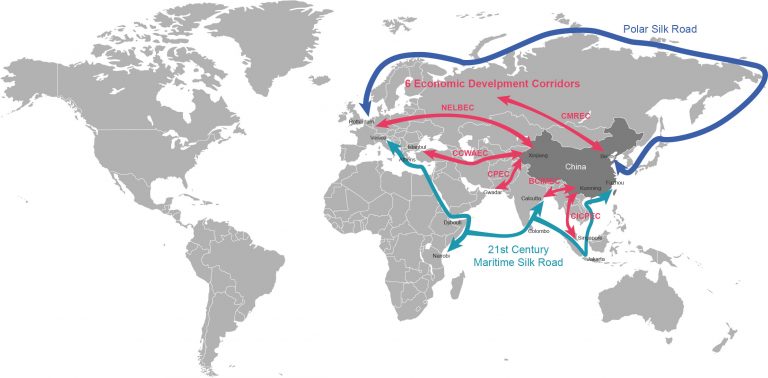
In March 2019, Italy became the first G7 nation to sign onto China’s Belt and Road Initiative. The Belt and Road Initiative is China’s companion strategy to Made In China 2025. If MIC25 is intended to grow domestic industries, BRI was meant to spread those industries across the world.
The Belt and Road Initiative is a broad collection of infrastructure construction projects performed in member nations. Countries sign up to have Chinese companies build roads, railroads, pipelines, ports, and power grids, all financed by Chinese banks. Over 60 countries have signed up since it was announced in 2013. Most member nations lie along the Silk Road—the ancient trade route that connected China to Europe. Using modern technology, China is making these old routes commercially viable again, integrating heretofore economically isolated and infrastructure deficient central Asian nations into a common trade enterprise. BRI also includes nations found along the ancient maritime Silk Road, which opened after the land route and ran through the Indian Ocean. Now even a 21st century version has been added. The Polar Silk Road, which runs through the Arctic Ocean north of Russia, has opened up due to melting ice caps. It has the potential to shave weeks off ocean transit between China and Europe.
By all appearances, China is trying to regain its glorious past. Long before the Age of Exploration made the trans-Atlantic the most profitable trade routes, the Silk Road dominated. Both then and now, these natural trade corridors connect major population centers (BRI member nations comprise 2/3 of the world’s population). BRI has the potential to make China the hub of the commercial world, shifting trade away from the Americas, and restoring China’s commercial dominance. As European nations join, the trade routes only strengthen.
Many countries are skeptical of the initiative. Developing countries often end-up owing China huge sums of money they cannot afford to pay. Western nations rightly see it as China’s attempt to gain influence. Whether or not one agrees with it, however, one can appreciate the elegance of the strategy—a strategy by a nation firmly committed to becoming the world’s leader by the end of the century.
Reference:
Chico Harlan, “Italy becomes first G-7 nation to sign on to China’s Belt and Road Initiative,” Washington Post, 24 Mar 2019, A18; also available from https://www.washingtonpost.com/world/europe/defiant-italy-becomes-the-first-g7-country-to-sign-on-to-chinas-belt-and-road-initiative/2019/03/22/54a732d4-4bdf-11e9-8cfc-2c5d0999c21e_story.html
Andrew Chatzky and James McBride, “China’s Massive Belt and Road Initiative,” Council on Foreign Relations, 28 Jan 2020; retrieved from https://www.cfr.org/backgrounder/chinas-massive-belt-and-road-initiative
Belt and Road Initiative, https://www.beltroad-initiative.com/belt-and-road/
Photo: beltroad-initiative.com
No responses yet