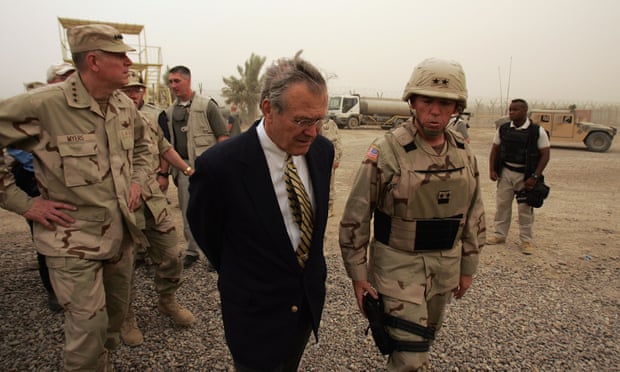
Donald Rumsfeld, former Secretary of Defense and principal architecture of the Iraq War, died last week. When the news broke in Iraq, many took to social media to express lingering anger and resentment. “He didn’t liberate us. This is a myth. He killed us and told us to thank him for it,” said one Iraqi living in Bagdad.
Rumsfeld launched an invasion seeking weapons of mass destruction. The invasion lasted three weeks; the conflict that followed lasted years. After US forces routed the Iraqi Army, civil war erupted and ripped apart the society. Americans were unsure of how to deal with extremist groups, militias, and sectarian violence. The Department of Defense did not have a plan for after the war. In the end, an estimated 400,000 Iraqis were killed as a result of US involvement. Half-again as much could be added if one considers the long-term impact of decisions made. Most Iraqis consider this time to be a dark chapter in their history.
Was any of this predictable? Perhaps not at the time. There were various positions on how the society would respond after the ouster of their president. However, now we can know better. Iraqi society ripped apart because it was inherently a fiefdom (ruled by kings, emirs, czars, etc.). So, when the US took out the ruling fief, the society fell to a lower level—a chiefdom (ruled by chieftains, sheiks, warlords, local bosses). Sectarian violence erupted as chiefdoms fought each other for dominance. The US has since been trying to move Iraq forward to become a nation-state, but this is a decades-long process.
Iraqis took to social media when Rumsfeld died. Many shared personal stories—the loss of loved ones, of being arrested without cause, of violence in a once peaceful neighborhood. Others mourned the loss of the country they once knew. Let us hope that this loss has at least given us lessons to learn from and encouraged us to make wiser decisions in the future.
Sources:
Qassim Abdul-Zahra, “Among Iraqis, the name Rumsfeld evokes nation’s destruction,” Associated Press, 1 July 2021, accessed from https://apnews.com/article/middle-east-iraq-government-and-politics-79145696fdfd387c61fee7ff1ff7eabc
Iraq Body Count, accessed from https://www.iraqbodycount.org/
Philip Bump, “15 years after the Iraq War began, the death toll is still murky,” Washington Post, 20 Mar 2018, accessed from https://www.washingtonpost.com/news/politics/wp/2018/03/20/15-years-after-it-began-the-death-toll-from-the-iraq-war-is-still-murky
Photo: David Hume Kennerly (Getty Images)
No responses yet