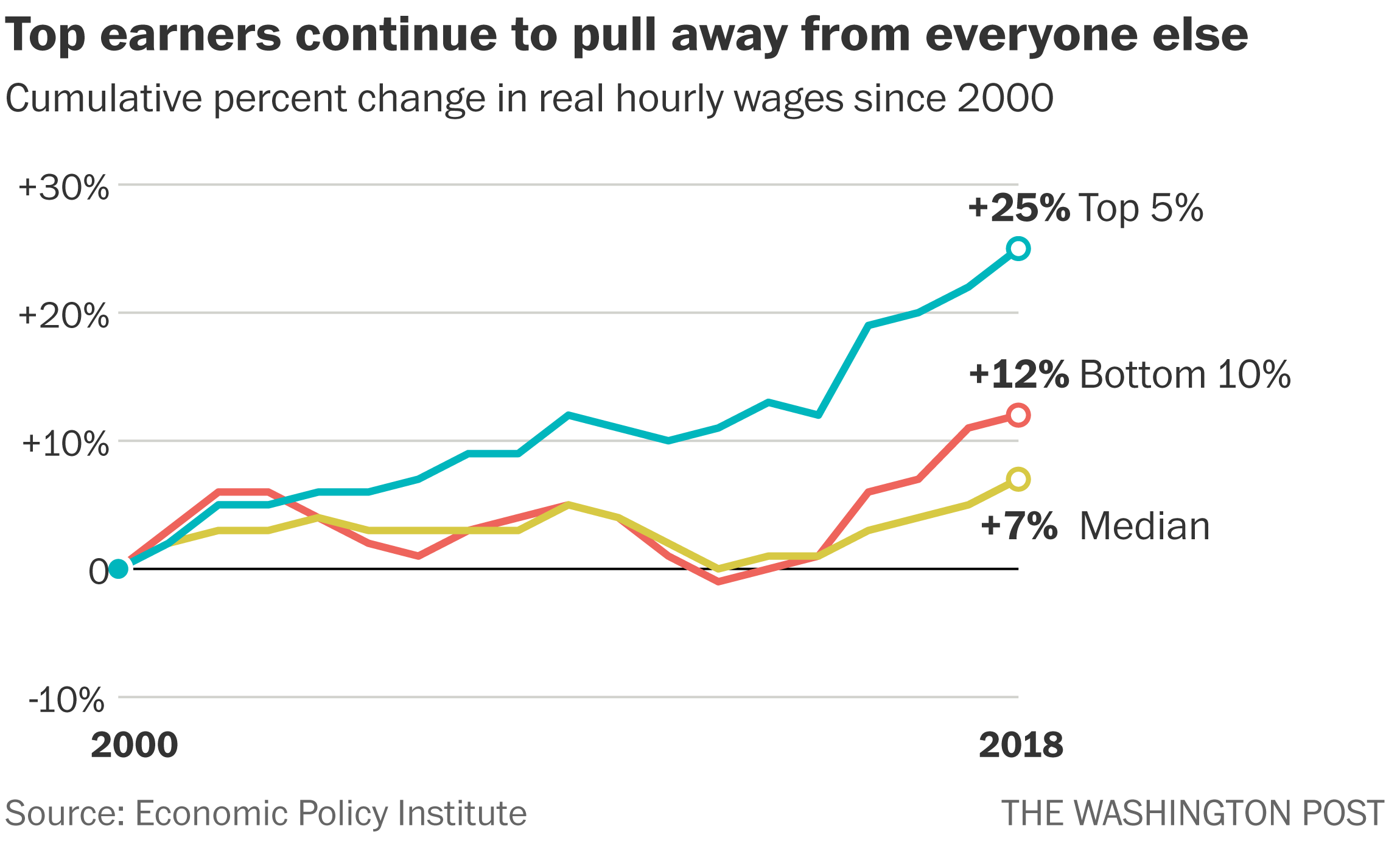
Last week, the Washington Post began a series of editorials looking at the growing wealth gap in the US over the last 30 years. Their focus is on wealth instead of income because is a better long-term metric of success; it includes assets such as bank accounts, houses, and other property.
Over the last 30 years in the US, the rich have gotten richer and the poor poorer. Currently, US household wealth is roughly $130 trillion dollars. Of that, the wealthiest 1% of Americans own about 32% and the top 10% own 70%. The bottom half own about 2%. These numbers have increased since 1989, when the top 1% and 10% owned 23% and 61%, respectively. In comparison, the top 10% of most industrialized nations average about 52%.
Is this a problem? Per capita wealth is one of the four leadership power sources; however, some deference has to be given to the distribution of that wealth. Wealth concentrated in too few hands reduces leadership power. Theoretically, if all the money in a society were in one person’s hands, there would be a tremendous solubility problem—money would not flow through society enough to stimulate the economy. A similar argument applies to wealth concentration. Furthermore, wealth concentration promotes instability. Greater household wealth enables the family to survive the shocks of daily living, while lower household wealth makes a family more vulnerable. Because a poor family has less to lose, it becomes more susceptible to demagoguery and other instability factors.
The US would be wise to correct this outage before it goes on much longer. The wealth gap is far greater than needed to incentivize entrepreneurship. In addition, closing this inequality is not socialism nor un-American because for most of America’s history, this wealth gap was not as great. In fact, US economic growth slowed during this period of wealth concentration. (Much of this wealth accrual has been the result of non-productive factors such as inheritance, speculation, and windfall rather than value creation.) The US would benefit from a tax system that gently tugs people back toward the middle.
Source: “The US is Growing More Unequal. That’s Harmful—and Fixable,” Washington Post Op-ed, 18 July 2021, A26; see also https://www.washingtonpost.com/opinions/2021/07/16/us-is-growing-more-unequal-thats-harmful-fixable/
Photo: Economic Policy Institute
No responses yet