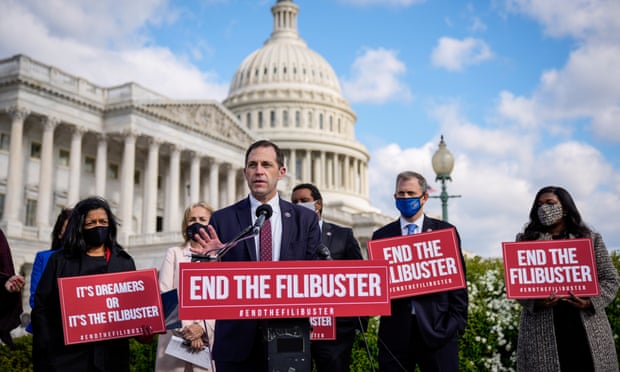
On Capitol Hill, voting rights is on-track to be the next big issue; however, some Democrats fear that nothing will happen unless the filibuster is eliminated. Regardless of whether one is Democrat, Republican, or indifferent, how a legislature functions is worth understanding.
The filibuster is the roundabout way the Senate establishes a supermajority of 60 votes for making decisions (as opposed to a simple majority of 51 votes). Technically, the Senate allows never-ending debate on an issue. In 1917, however, it changed its rules to allow a 66-vote majority to end debate. In 1975, it lowered that threshold to 60 votes. The effect is that bills generally need 60 votes to pass. Senators like the filibuster because it has historically forced discussion and compromise between the parties. However, current politics is causing the Senate to reevaluate this rule. Some deem eliminating it as necessary for advancement, while other see eliminating it as chaos inducing. Even some Senators who want voting rights legislation won’t kill the filibuster to pass it.
Democracy functions on cooperation—at some point, deep-down, decision-makers believe that everyone will be better off if they come together in agreement, even if that means giving up something in the process. So when decision-makers decide not to work together as a matter of principle, democracy weakens. In today’s rancor, the current 60-vote threshold has become an impediment. It no longer forces debate; rather Senators pout and wait for their turn to legislate. The consequence of this attitude is born by the citizenry who sees nothing getting done. It is time to lower the bar to a 55-vote majority. This better reflects the current environment and better balances the need for discussion with the need to move legislation forward.
If Congress somehow becomes cordial again, the limit could be re-elevated. But much has changed since the days when Ronald Reagan and Tip O’Neill sparred during the day and had drinks together in the evenings. One can hope that America will someday emerge from the current toxic environment. Until that happens, adjusting the rule to fit the conditions makes sense.
Source:
Mike DeBonis, Sinema Holds Firm in Support of Filibuster, Imperiling Voting Rights Push, Washington Post, 21 November 2021, A18\; see also https://www.washingtonpost.com/politics/sinema-filibuster-voting-rights/2021/11/19/6be2b338-4966-11ec-95dc-5f2a96e00fa3_story.html
“About Filibusters and Cloture,” U.S. Senate, accessed 8 Dec 2021 from https://www.senate.gov/about/powers-procedures/filibusters-cloture.htm
Photo: Getty Images
No responses yet