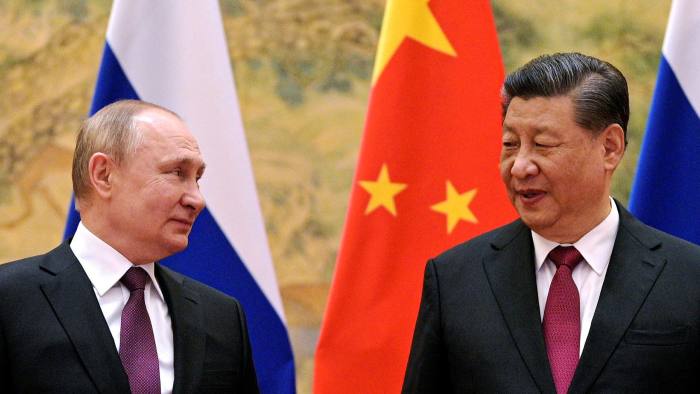
After four decades of forging tighter relationships with the US, China is now looking elsewhere for a partner. Last week, Vladimir Putin and Xi Jinping met in a summit, prior to the opening ceremony of the Winter Olympics, to confirm their solidarity on several issues.
China and Russia pledged greater economic cooperation and inked a $114B trade deal. They pledged to mutually support programs such as China’s Belt and Road Initiative, Russia’s Eurasian Economic Union, forming a joint-airlines, Russia’s construction of two power plants in China, and construction of a second natural gas pipeline between the two countries. They also denounced the US six times by name. They criticized US military presence in the Indo-Pacific, and AUKUS—the pact between the US, UK, and Australia. China joined Russia in opposing the expansion of NATO, and Russia joined China in opposing Taiwanese independence. They both opposed the “politicization of the issues of combating terrorism”—i.e., opposition to cracking-down on Uighurs. Finally, they declared: “It is up to the people of the country to decide whether their State is a democratic one”—offering authoritarianism as an alternative to democracy.
While there is no danger of them forming a union (they each want to be in power), they both have incentive to discredit democracy and to mutually support one another’s authoritarian regimes. Over time, their relationship could become a strong counterweight to the US-European alliance. They see this as the principal fight on their hands.
This is the strongest agreement between Russia and China since the late-1950s, when the two had a falling out over Communist ideology. Yet beyond economic projects, the agreement doesn’t make specific commitments. Ukraine is not mentioned—evidence that China is unwilling to green-light an invasion. And there is no promise of direct economic support if Russia invades and the US imposes sanctions. While China could make up much of Russia’s trade loss, it would then face US sanctions, stalling its economy. As one former Obama Administration official in charge of Asian affairs put it: This is a relationship based on “pragmatism, not ideology.”
Source: Chao Deng, Ann M Simmons, Evan Gershkovich, William Mauldin, “Putin, Xi Aim Russia-China Parnership Against US,” Wall Street Journal, 4 Feb 2022; accessed from https://www.wsj.com/articles/russias-vladimir-putin-meets-with-chinese-leader-xi-jinping-in-beijing-11643966743
Eva Dou, What is—and isn’t—in the Joint Statement from Putin and Xi in Beijing,” Washington Post, 6 Feb 2022, A17; see also https://www.washingtonpost.com/world/2022/02/04/russia-china-xi-putin-summit-statement-beijing/
Photo: Associated Press
No responses yet