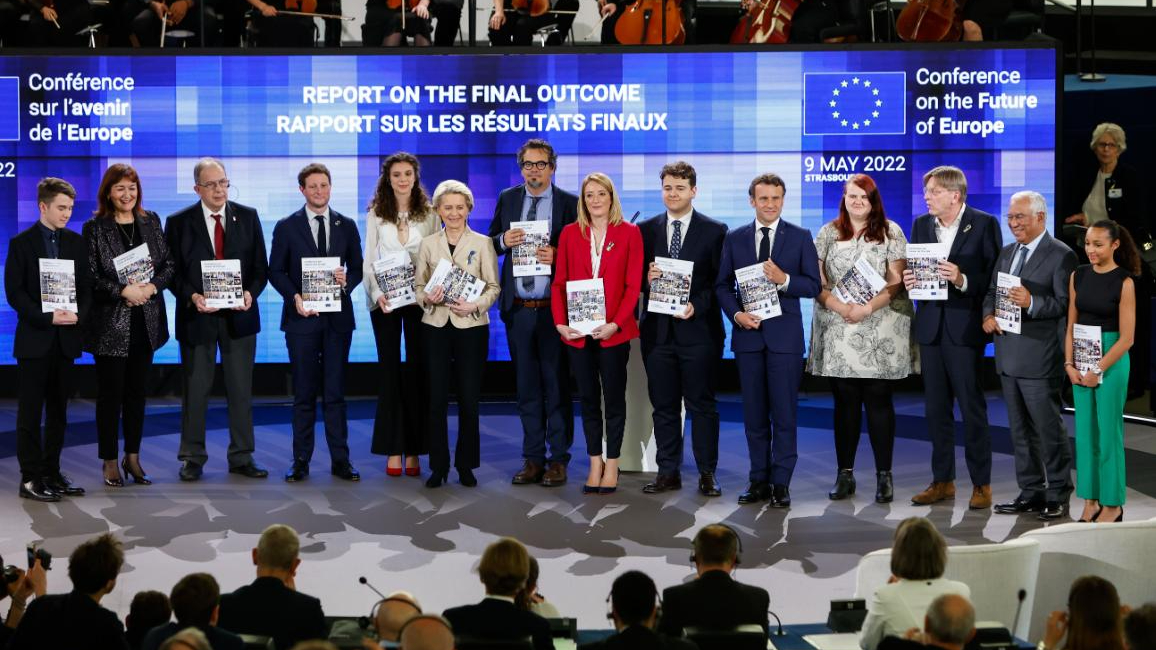
The EU just concluded its Future of Europe Conference. It was a yearlong forum intended to come up with ideas for political reform. The conference produced a lengthy report that included 49 recommendations and over 200 policy proposals.
The main recommendations called for a greater integration of nations, and a shift from unanimity decision-making to majority decision-making. The current unanimity requirement says that all nations must agree before a decision is made. Though it may have made sense when the EU was smaller, it has long since been considered a stumbling block to progress: it gives any country a veto over any measure to be undertaken by the entire bloc. (Recently, Hungary was able to stall the ban on Russian oil imports using it.) Another recommendation promoted multi-speed accession into the EU—countries with a more central geography and more common values (such as the remaining Balkan states, Ukraine, or a returning UK) would be able to advance faster.
The war in Ukraine exposed flaws in the EU’s ability to manage basic aspects of its existence, especially in areas of security and energy. Acting more like a single government is seen as a fix. However, the EU is currently a monetary union and has a couple of more stages before it reaches full political union. If historical trends hold, this will not occur until a transformative innovation comes along that creates the conditions that warrant such a change. As such, total union is still a long way off. Nevertheless, the conference reveals an interest in moving that direction.
Germany and France took the lead on pushing for reforms. They even called for the European Parliament to convene a conference to revise the EU treaty. They were staunchly opposed, however, by thirteen countries, including all the Scandinavian and Baltic states. (“[We] do not support unconsidered and premature attempts to launch a process toward treaty change.”) Some say most of the recommendations are possible without changing the treaty, offering that a fine-tuning of EU strategy would suffice. Given that a treaty change requires unanimity, that may be a better approach, at least for now.
Source:
Laurenz Gehrke, “EU Treaty Change ‘Not a Taboo,’ say Scholz, Politico, 5/19/2022; accessed from https://www.politico.eu/article/eu-treaty-change-not-a-taboo-says-german-chancellor-scholz/
Alice Taylor, “Scholz and Macron to Reignite Franco-German Engine on EU-integration,” Euractiv, accessed from https://www.euractiv.com/section/global-europe/news/scholz-and-macron-to-reignite-franco-german-engine-on-eu-integration/
Sophia Russack, “The Good, the Bad, and the Ugly of the Conference on the Future of Europe,” CEPS, 12 May 2022; accessed from https://www.ceps.eu/the-good-the-bad-and-the-ugly-of-the-conference-on-the-future-of-europe/
Photo: European Parliament
No responses yet