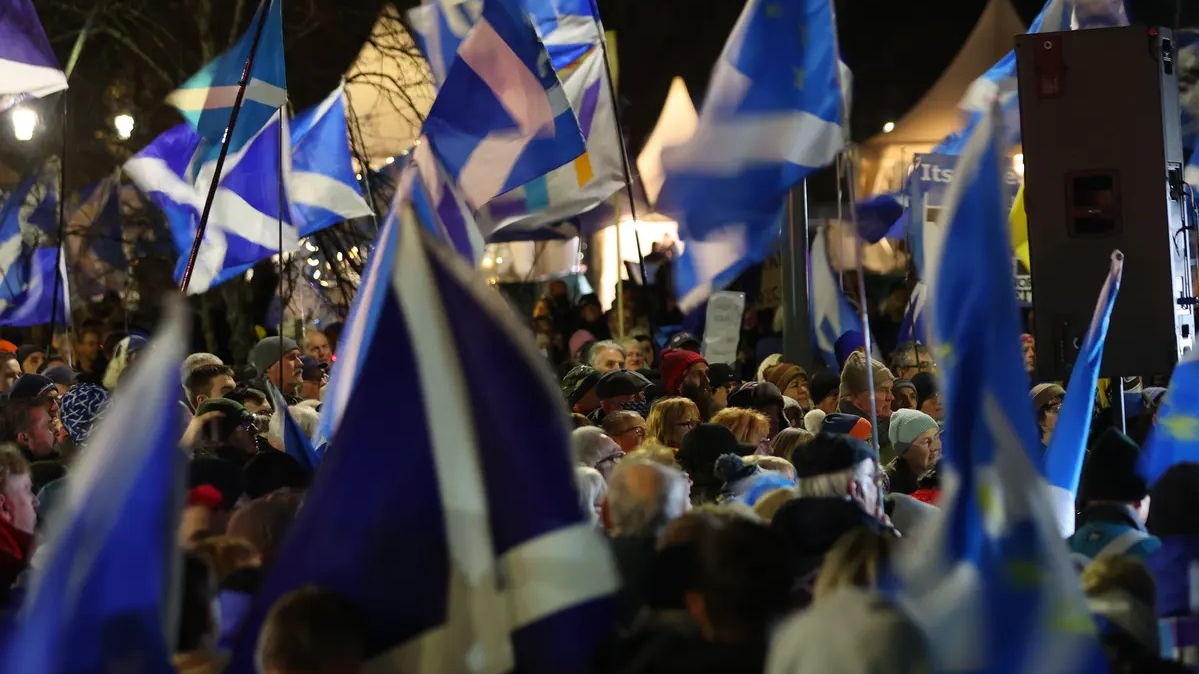
Last week, the United Kingdom’s Supreme Court ruled that Scotland’s parliament could not call for another independence referendum, putting to rest, at least for a time, that Scotland could break away from the UK and rejoin the European Union.
In 2014, Scotland held an independence referendum, and the British government even consented to it. Roughly 55% of Scots voted to remain in the UK. Then in 2016, the UK voted to leave the EU–or rather England, Wales, and Northern Ireland voted to leave, but Scotland overwhelmingly voted to stay (62-38%). Immediately, there were calls for another independence referendum, but it was blocked by then-British Prime Minister Theresa May. A lawsuit worked its way through the courts while three other prime ministers—Boris Johnson, Liz Truss, and now Rishi Sunak—opposed the second try. The first referendum was a “once in a generation” vote and the issue had been settled, argued Boris Johnson.
The UK was formed in 1707 when England and Wales merged with Scotland. (Ireland joined in 1801, but the southern counties left to form their own country in 1922.) When the UK was formed, England’s parliament essentially became Britain’s parliament, and the Scottish parliament dissolved. Scotland’s parliament resurrected in 1999 when British parliament devolved (delegated) some of its authority, after a Scottish referendum two years earlier. Now, Scotland wants to go further and achieve total independence, believing that its economy would be better off. However, unlike BREXIT, where the UK left an institution less than 30-year-old, Scotland is trying to leave an institution more than 300-year-old. The bindings have grown tight over the centuries—at this point, it would be nearly impossible to separate the governance and infrastructure.
The Scottish National Party leader in the House of Commons, Ian Blackford, declared, “the very idea that the United Kingdom is a voluntary union of nations is now dead and buried.” The First Minister of Scotland, Nicola Sturgeon, has vowed to fight on by making the next general election a referendum on Scottish independence. How this is to be done, however, is not clear.
Source:
William Booth, “Scotland Loses on Independence Vote,” Washington Post, 24 November 2022, A15.
Jenni Reid, “Scotland Cannot Hold an Independence Referendum without UK Government Approval, Top Court Rules,” CNBC, 23 November 2022; accessed from https://www.cnbc.com/2022/11/23/scottish-independence-movement-dealt-blow-by-supreme-court.html
“Scottish Parliament,” Wikipedia, accessed 29 November 2022.
“Devolution,” Wikipedia; accessed 29 November 2022.
Photo: Murdo MacLeod (The Guardian)
No responses yet