The national debt ceiling will be a hot topic this summer as Democrats and Republics tussle over whether to raise it. By summer, Treasury Secretary Janet Yellen will have run out of tricks to avoid a US default. All of this begs the question of how the debt got so high in the first place.
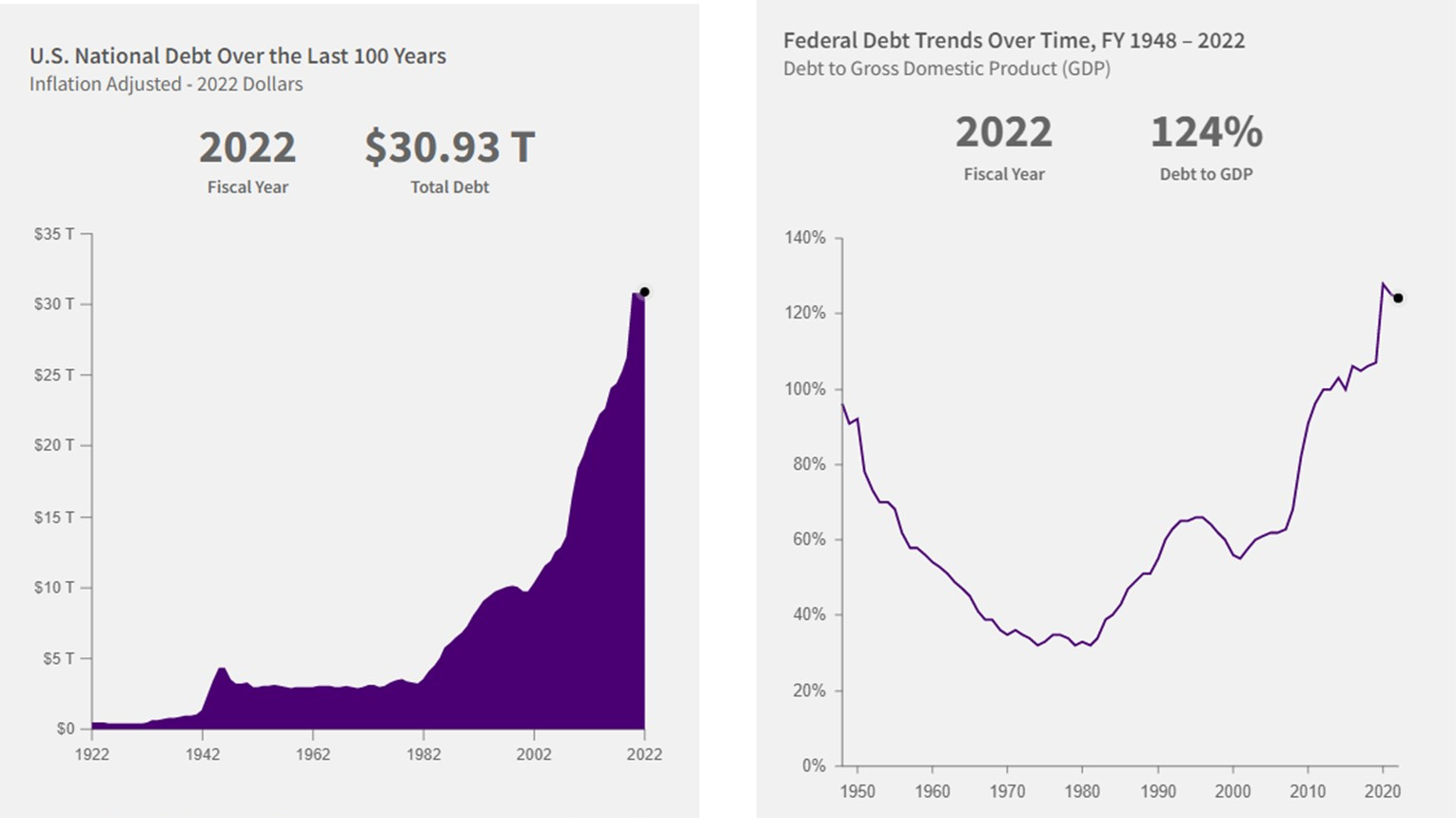
The national debt has grown almost entirely in the last forty years, and both parties were responsible. After World War II, the US debt as a percentage of GDP peaked at 106%. This was followed by three decades of decline as the US economy grew. Then in 1982, President Reagan used debt to fund tax cuts and higher defense spending. The debt tripled from $700B to $2.1T during his tenure, and debt:GDP rose from 32% to 51%. The rise continued through the Bush years and temporarily reversed during the Clinton years, largely due to a growing economy. Since that time, government action has only contributed to the debt:
- Bush II tax cuts, 2001, $1.5T
- Wars in Iraq and Afghanistan, starting in 2003, $4-6T
- Medicare Part D expansion, 2006, $.4T
- Great Recession response, 2009, $2T
- Obama extension of Bush II tax cuts, 2013, $4T
- Trump tax cuts, 2017, $1.5-2.9T
- Trump spending, 2019, $2T
- COVID response, 2020, $6.2T
- Biden spending, 2022, $.4T
Currently, debt:GDP stands at 124% and interest payments are almost $400B a year—one of the largest annual federal outlays.
Since the 1980s, there has been a change in how people perceive debt. There has been less compulsion to beat it down than there was in the late-1940s. Nonetheless, debt is the opposite of wealth and wealth is one of four leadership powers; so higher debt only means a weaker America in the long run.
A recent poll found that 57% of Americans believe reducing the budget deficit (which increases debt) is a top priority, up from 45% last year. Perhaps more people want to see a correction for the spending that occurred during COVID. Whatever the motive, let us hope things don’t have to reach desperation levels before meaningful fiscal responsibility is restored (or perhaps we’re already there and don’t know it).
Source:
Jeff Stein, “See How the National Debt Grew to $31T,” Washington Post,12 March 2023, G4.
Drew Desilver, “5 Facts about the US National Debt,” Pew Research Center, 14 February 2023, accessed from https://www.pewresearch.org/fact-tank/2023/02/14/facts-about-the-us-national-debt/
“What is the National Debt?”, Fiscal Data, US Treasury, 15 March 2023, from https://fiscaldata.treasury.gov/americas-finance-guide/national-debt/
Andrew Glass, “US Nations Debt Tops $1 Trillion, Oct. 22, 1981,” Politico, 22 October 2017.
“Reaganomics,” Wikipedia, accessed 14 March 2023.
Photo: US BLS, US BEA
No responses yet