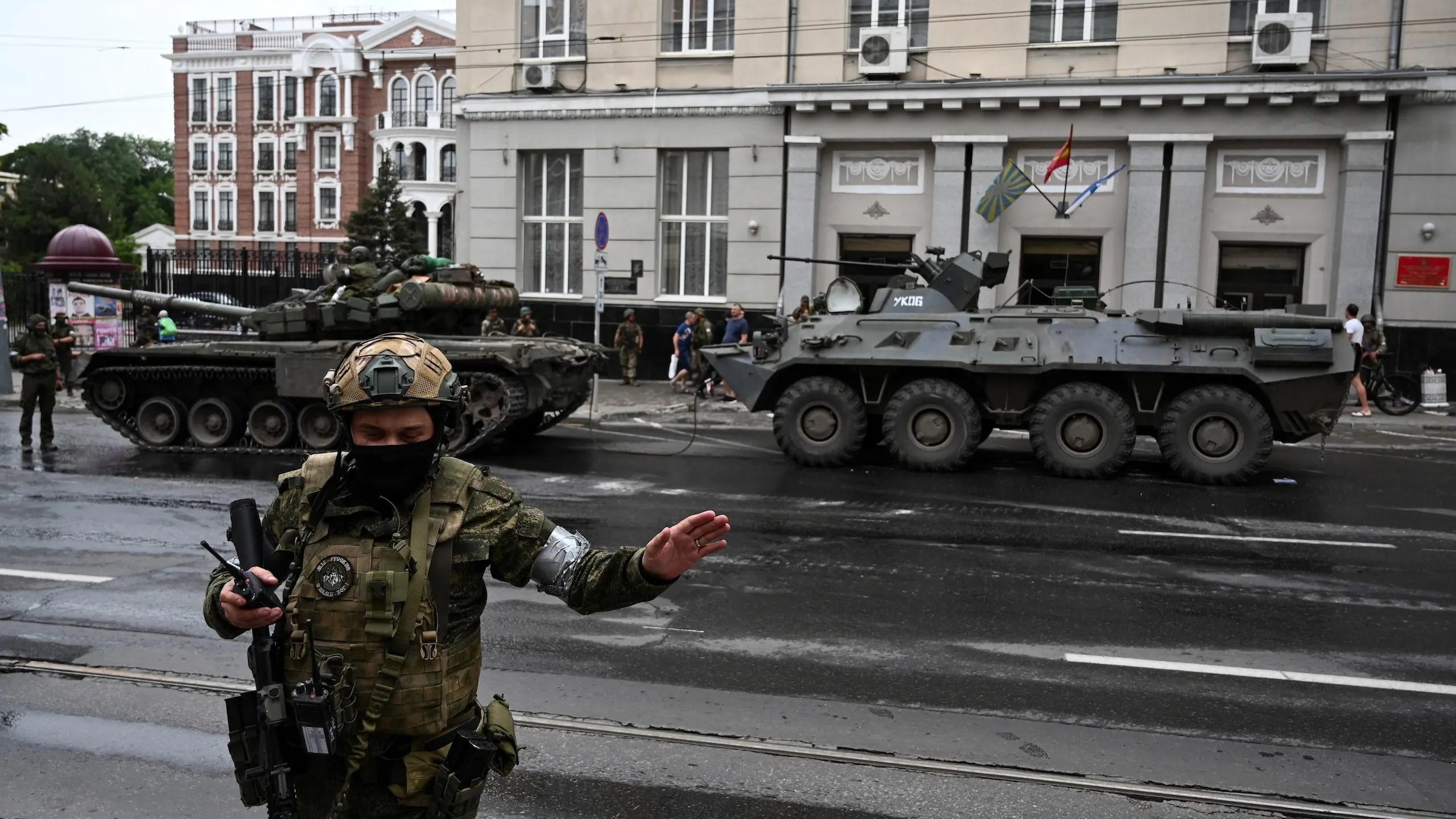
On June 24, an armored column of about 5,000 Russian soldiers began a trek toward Moscow in an apparent mutiny. The revolt was perhaps the gravest attack on Putin’s leadership in his 23-year tenure and revealed shortcomings not only in the conduct of the Ukraine War but also in his mindset.
On June 23, a group of Russian soldiers that had been fighting in Ukraine seized a Russian airbase at Rostov-on-Don, about 400 miles to the east. The soldiers were from the Wagner Group, a private army founded in 2014 by ex-convict, turned entrepreneur, Yevgeniy Prigozhin. Russia had hired the group to augment its forces in the war. After seizing the airbase, the group turned north toward Moscow, 670 miles away. Security forces in the Russian capital began preparing defensive positions, and the column was challenged mid-way, near Voronezh, but otherwise moved largely unimpeded. Ultimately, it halted within 120 miles of the city. Prigozhin, a one-time Putin ally, claimed he was trying to force a change in military leadership. Perhaps a more compelling reason was that members of “volunteer formations” were to be pulled into the Russian military, effectively dissolving the Group. Whatever the reason, the mutiny exposed weaknesses in Putin’s regime. The use of mercenary troops in general was shocking to many Russians, and Prigozhin went as far as to say that neither Ukraine nor NATO posed a security threat to Russia and that Putin had been tricked into going to war by his generals.
The mutiny and the war in general is a remnant of 20th century thinking. Gone are the days when the Soviet Union could bully its neighbors into submission. Putin has failed to realize that making yourself attractive to your neighbors is the path to regaining a leadership position in the world order. Nation-unions will likely begin to form by the end of this century, but Putin’s actions have further isolated Russia, weakening its prospects.
On the evening of June 24, Prigozhin accepted an offer of immunity, provided he lay down his arms. He is in now in exile in Belarus. His soldiers were offered positions in the regular Russian army or the chance to flee to Belarus. While a quick ending to the uprising avoided much bloodshed, it did reveal that the sooner Russia finds a more forward-thinking leader, the sooner it may actually return to a position of status in the world.
Source:
Catherine Belton, Robyn Dixon, “Mercenary Uprising is Reckoning for Putin’s Rule,” Washington Post, 25 June 2023, A1; see https://www.washingtonpost.com/world/2023/06/24/putin-wagner-prigozhin-mercenaries/
Robyn Dixon, Catherine Belton, Mary Ilyushina, Claire Parker, “Wagner Group Halts Advance to Moscow,” Washington Post, 26 June 2023, A1; see https://www.washingtonpost.com/business/2023/06/24/russia-ukraine-wagner-prigozhin/story.html
Armani Syed, Anna Gordon, “Russian’s Notorious Wagner Group is Being Disbanded. Here’s What That Means for Ukraine,” Time, 27 June 2023; see https://time.com/6290536/russia-wagner-group-disbanded-ukraine/
“Wagner Group,” Wikipedia.
Photo: Reuters
No responses yet