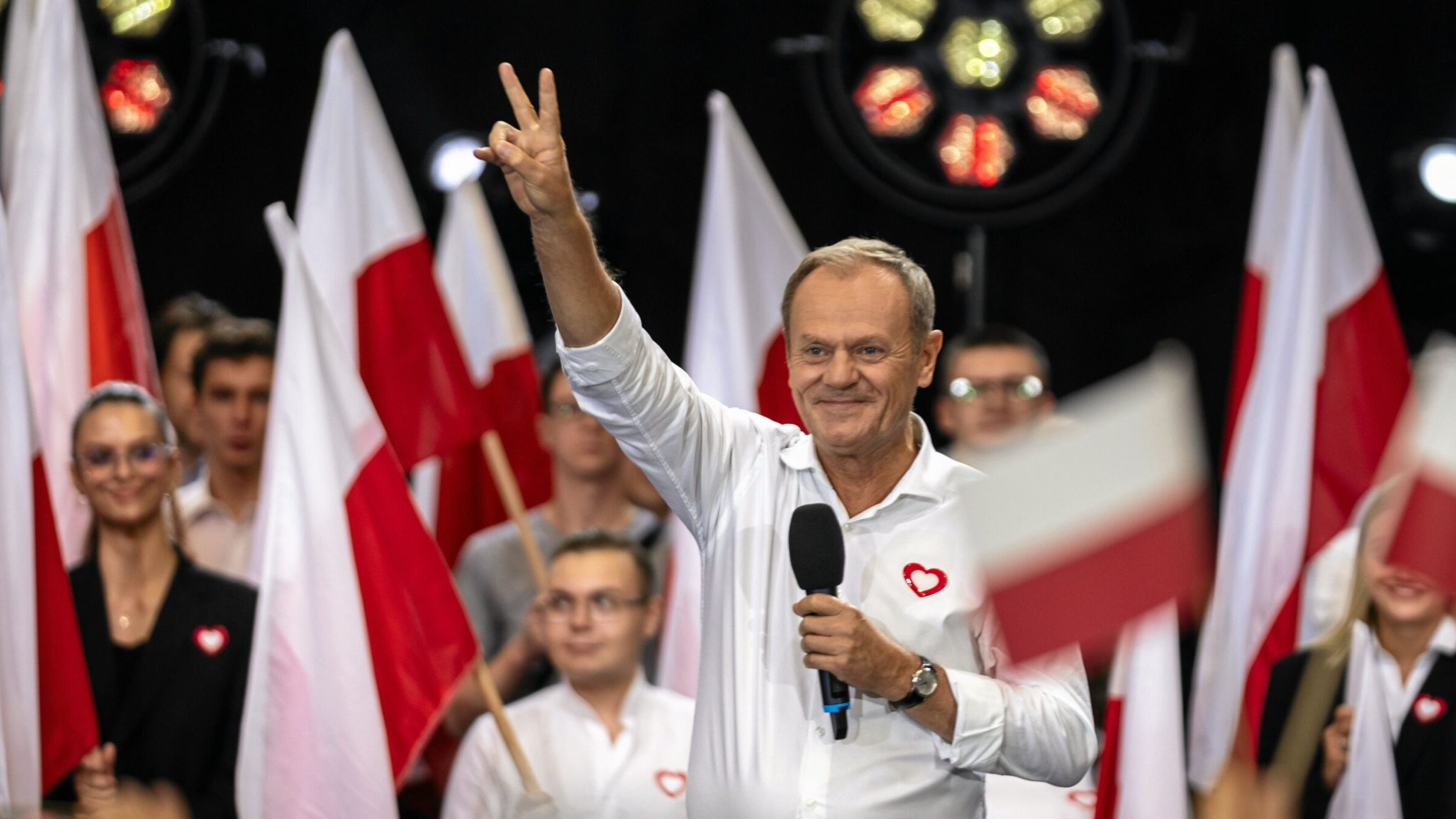
Last month, Poland ousted a populist authoritarian government—the first time a European country that has thrown off such a yoke. In doing so, Poland provides a potential path forward for other nations.
For eight years, an authoritarian government has run Poland. The Law and Justice party (PiS) took over state-owned companies and appropriated security agencies. The state-owned media became their propaganda tool. Opposition leaders were targeted with smear campaigns. Independent-minded businessmen were jailed. Critics had their phones bugged. The federal courts were packed with loyalists. Allegiance to the party became the only way to preserve one’s career. Then Donald Tusk, the former prime minister from 2007 to 2014, returned to Polish politics, where he re-energized opposition candidates and spearheaded election campaigns. It was a success. The election voter turnout was 74%–the highest in 30 years. While PiS still won the most seats, it did not win an outright majority, so it needs to form a coalition to govern. Because smaller parties are already aligned with the centrist Civic Coalition, PiS will be forced from power.
European countries have been sliding backward toward authoritarianism for a decade. Once voted in, an authoritarian party exploits weaknesses in their country’s constitution to gain more power. Poland shows there is a way out, however. Compared to Hungary, which has had an authoritarian government since 2010, Poland has a more vibrant civil society—more people actively participate in elections and governance. The PiS was not able to silence them. Young people in particular became more engaged. Also, Poland has seen less emigration than Hungary—people stayed around to vote the party out, whereas Hungarians simply left.
The new government will likely find it challenging to reestablish rule-of-law. The laws were re-written for PiS’s desires, and Poland’s President is a PiS loyalist with the authority to veto reform legislation. (His term ends August 2025.) Also, seeking justice for past wrongs cannot appear as political reprisals or it could stifle reform efforts. So, while challenges exist, Poland’s success does offer insight on how other countries might be able to restore their democracies.
Sources:
Lee Hockstader, “Donald Tusk’s Task is to Pick Poland’s Authoritarian Lockbox,” Washington Post, 12 November 2023, A27.
Jan Cienski, “Poland Election Results: Opposition Secures Win, final Count Show,” Politico, 17 October 2023; accessed from https://www.politico.eu/article/poland-election-results-opposition-donald-tusk-wins-final-count-civic-platform-pis/
Pawel Zerka, “Message in a Ballot: What Poland’s Election Means for Europe,” European Council on Foreign Relations, 18 October 2023; accessed from https://ecfr.eu/article/message-in-a-ballot-what-polands-election-means-for-europe/
Matthias Matthijs, “How Poland’s Election Result Could Reshape Europe,” Council on Foreign Relations, 19 October 2023; accessed from https://www.cfr.org/in-brief/how-polands-election-results-could-reshape-europe
Photo: Getty Images
No responses yet