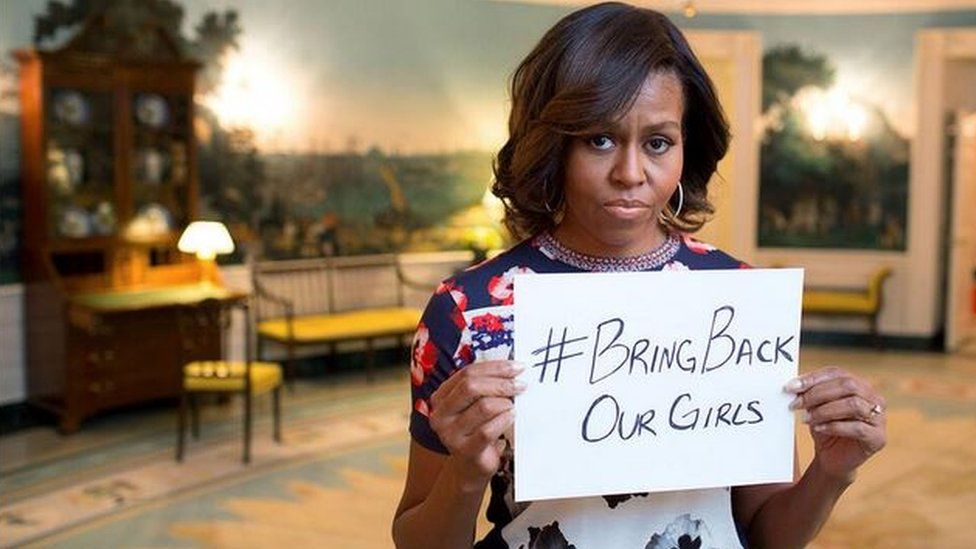
Seven years ago this month, 276 teenage girls were kidnapped by Boko Haram in Nigeria. Less than half were ever set free. The tragedy reveals the danger of living in that part of Africa. The novelty is that we even know about it. We know about it because of the social media campaign that exposed it.
The outcry over the kidnapping was one of the early social movements fueled by social media. Everyone from Ellen DeGeneres to Michelle Obama retweeted #BringBackOurGirls. The campaign was initially dismissed as irrelevant by the Obama Administration (despite the tweet), but ultimately the opposite proved true. The wave of support caused nations to lend helicopters, drones, satellite imaging, and even Special Forces to find them. Donations paid for a company of South African mercenaries to look for them. Ultimately, however, it was secret negotiations organized by Switzerland, along with Nigerian volunteers carrying bags of money on motorbikes at night, that got the girls released—or at least some of them.
The event showed the depth to which social media could influence political priorities. Before this, few would have imagined it could have any impact. Yet the world was beginning to grow more connected through this new technology. The collective voice of millions could now be heard—and it was heard by government leaders.
Sadly, less than half of the girls were ever released—only 103 of them; the rest were declared missing. Also sadly, social media made Boko Haram a household name, boosting their presence on the world stage, which they then used to forge an alliance with the Islamic State. Perhaps worst of all, the publicity made mass abduction a growth industry in Nigeria. In just the last year, there have been five mass abductions of students, totaling almost a thousand children. While raising a collective voice creates power, knowing how best to use it is something societies still grapple with.
Source:
Joe Parkinson, Drew Hinshaw, “How Twitter Activism Remade the Fight Against Boko Haram, Washington Post, 18 Apr 2021, B1; see also https://www.washingtonpost.com/outlook/slacktivism-chibok-twitter-our-girls/2021/04/16/0e3b9fee-9e1f-11eb-8005-bffc3a39f6d3_story.html
Seth Stern, “Are more eyes better? How social media can worsen foreign crises,” Christian Science Monitor, 26 Apr 2021, accessed on https://www.csmonitor.com/Books/Book-Reviews/2021/0426/Are-more-eyes-better-How-social-media-can-worsen-foreign-crises
Photo: Office of the First Lady
No responses yet