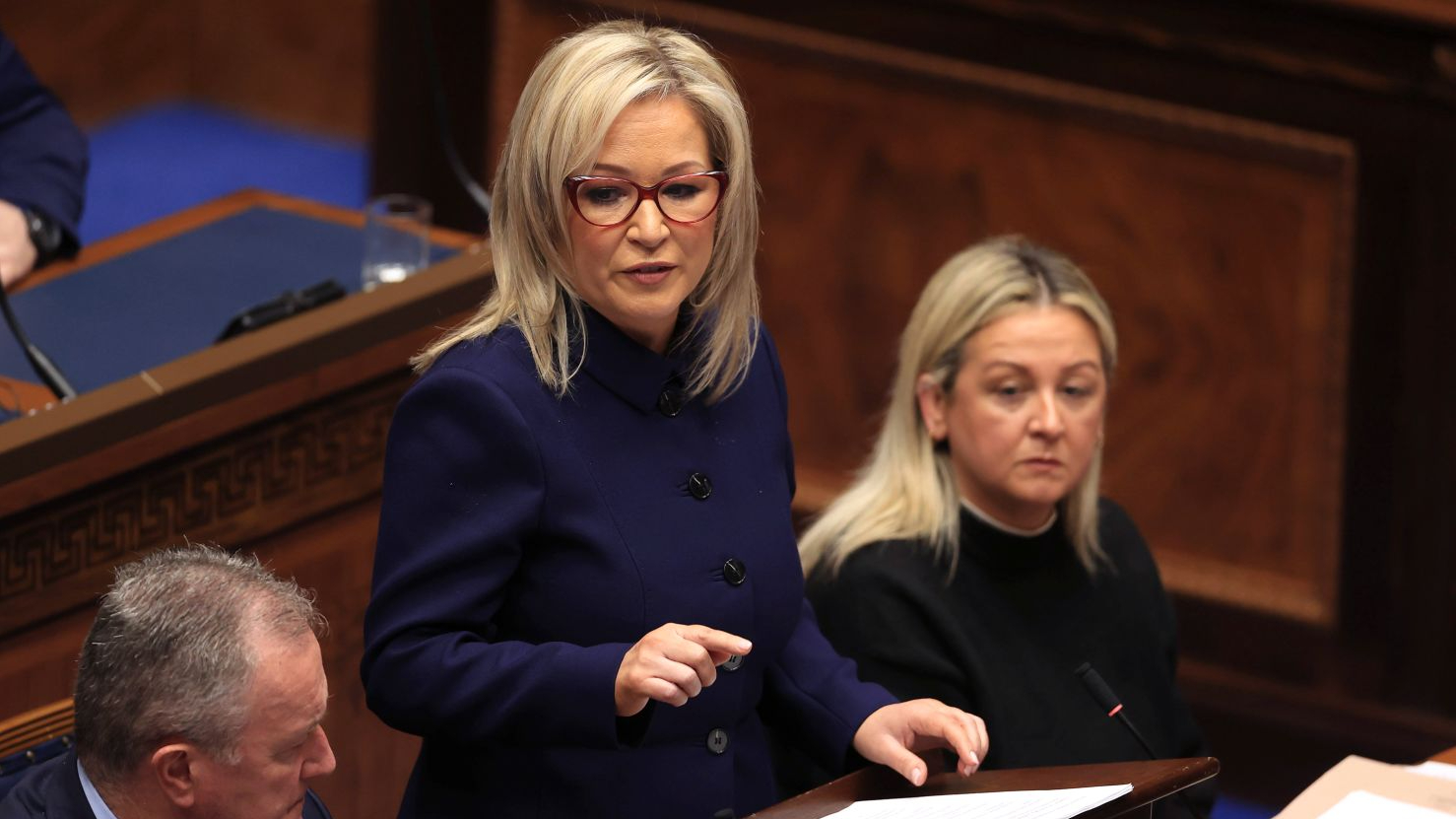
Last month, Michelle O’Neill, 47, became Northern Ireland’s first First Minister from the Sinn Fein party. For many, it was a day they never thought would happen.
Michelle O’Neill is Catholic from a self-described hard-scrabble upbringing, and whose family were members in the Irish Republican Army. Sinn Fein is the political party in Northern Ireland with historical links to the IRA. The IRA operated in Northern Ireland from 1969 to 1998 with the intent to secure rights for Catholics in Northern Ireland, through violence if necessary. Over 3,500 people were killed in the conflict known as “The Troubles.” In a May 2022 election, Sinn Fein won a majority of parliamentary seats, and the right to select the First Minister. After two years of unionist boycotts, parliament reconvened, and the first order of business was to select a First Minister. After ratification, O’Neill announced that she would work for all people: unionists and republicans, Protestants and Catholics, those who want a united Ireland and those who want to remain “British forever.”
Ireland was partitioned into northern and southern Ireland in 1921. Northern Ireland was dominated by Protestant descendants of Scots and Brits who migrated to the region in the 17th century. Southern Ireland, which would become the Republic of Ireland, was comprised predominantly of Catholic native Irish. Sinn Fein’s goal is for Ireland to become a single country again. BREXIT boosted this cause by highlighting commonality amongst those who shared the island contrasted to the relational distance from those across the Irish Sea. In the long-run, geography is the predominant influence on a society: it shapes cultural identities among groups within an area. As such, geography would suggest that Ireland will ultimately become a single nation again, though it may take generations. For many, a Sinn Fein First Minister is an indicator of that eventuality.
Michelle O’Neill will share power with the Deputy First Minister, Emma Little-Pengelly of the Democratic Unionist Party. As co-leader, some say her position is mainly symbolic. However, her selection is a progress milestone, nonetheless. In her acceptance speech, she admitted, “I am sorry for all the lives lost during the conflict [The Troubles] …I will never ask anyone to “move on,” but I do hope that we can “move forward.”
Source:
William Booth, Amanda Ferguson, “A First in Northern Ireland: Sinn Fein First Minister Leads New Government,” Washington Post, 4 February 2024, A18; see also https://www.washingtonpost.com/world/2024/02/03/northern-ireland-sinn-fein-michelle-oneill/
“Partition of Ireland,” Wikipedia; accessed 5 March 2024.
“Plantation of Ulster,” Wikipedia; accessed 5 March 2024.
Photo: Liam McBurney (AP)
No responses yet