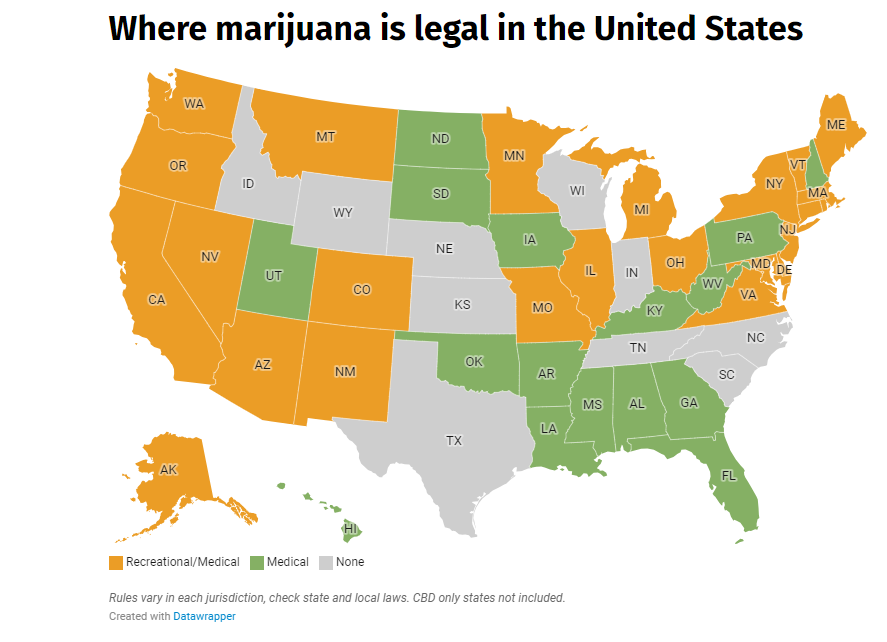
In 2022, the Biden administration tasked the Department of Health and Human Services to look at whether marijuana should remain classified as a Schedule I drug. Schedule I places it in the same category as heroin. This classification has led to conflicting laws across the country and illustrates the concept of legal incoherence.
By the end of 2023, 40 states had legalized medical marijuana and 24 had legalized recreational use. However, marijuana remains illegal on the federal level. In fact, it is still classified as Schedule I, alongside heroin, LSD, ecstasy, and peyote. In 2022, President Biden directed HHS to review whether it should remain on the highest of five schedules. Remaining on Schedule I makes it difficult to study in a laboratory. Many veterans suffering from PTSD have sworn to its benefits, so further studies could confirm its value. So far, the few studies conducted have shown mixed results, however. It did help some with nausea and vomiting; it has not shown much benefit for epilepsy or anxiety; and it may worsen some symptoms and nullify other treatments. In one PTSD study, patients using it showed marked improvement but not better than the placebo.
In World Leadership, I used drug schedules as an example of legal incoherence—where part of the legal code works against other parts. That marijuana is legal in some states but illegal federally is an example of legal incoherence. The nation that eliminates legal incoherence positions itself to become a leader in the future because it can manage resources better than others. This means aligning its laws hierarchically (state and federal) and longitudinally (over time), and even linking them to expenditures. Doing this will require a digital legal infrastructure, however, which is becoming possible with technology on the horizon. Such changes parallel ones that took place with the advent of the printing press, six hundred years ago.
In August 2023, HHS notified DEA that it recommends moving marijuana to Schedule III, placing it alongside prescription medications such as ketamine and testosterone. The DEA is expected to rule on this in the coming months. Meanwhile, the FDA is reviewing about 150 applications for marijuana-related studies. Perhaps soon, science will be able to determine whether this mysterious plant has any real medical benefits.
Source:
David Ovalle, Fenit Nirappil, “Federal Rules Hinder Studies of Marijuana’s Health Effects,” Washington Post, 3 March 2024, A1; see also https://www.washingtonpost.com/opinions/2024/03/10/marijuana-regulation-potency-cannabis/
“Where Marijuana is Legal in the United States,” MJBizDaily, accessed from https://mjbizdaily.com/map-of-us-marijuana-legalization-by-state/
“Drug Scheduling,” DEA, accessed 15 March 2023 from https://www.dea.gov/drug-information/drug-scheduling
Photo: MJBizDaily
No responses yet